The One Truth: Moving From Separateness to Oneness to Elevate Your State of Mind

The One Truth

WHY do we feel anxious, disconnected, insecure, cluttered, and chronically stressed? Moments when we feel stuck with no way out. As counterintuitive as it sounds, it’s not your circumstances that make you feel that way.

Jon Gordon explains in The One Truth that it’s always your state of mind that determines your performance. We are either in a low state of mind or a high state of mind.

A low state of mind is characterized by a lot of thought, a lot of clutter, fear, anxiety, worry, insecurity, and/or doubt. A high state of mind consists of a lot of clarity, focus, belief, and confidence.

He says that if you make a mistake in a low state of mind, you begin to question and doubt yourself. “But if you make the same mistake while you are in a high state of mind, you just brush it off and move forward. You have a next-play, next-moment mindset and look forward to the next opportunity.”

Of course, we all go through high and low states for various lengths of time. It’s part of being human and how our thoughts work. When we experience a low state of mind, we need to stay in the game, understanding that this happens to all of us, and not let it get the better of us.

Gordon identifies the Five D’s that sabotage us:

The first is Doubt. Doubt breaks us down, and we begin to question ourselves and begin to feel weak and powerless.

The second D is Distortion. These are the lies we tell ourselves about ourselves that lead to discouragement.

The third D is Discouragement. “This happens when the doubt and distortion (negative thoughts) overpower your mind, seep into your soul, and cause pessimism, apathy, and hopelessness. We don’t give up because life is hard. We give up because we get discouraged.”

The fourth D is Distraction. Distractions keep us from what matters most. “Distractions are the emeny of greatness and a soul-nourishing life.”

The fifth D is Division. This is what happens “when you experience doubt, believe in distortions, get discouraged, and find yourself distracted. You feel divided.” We spiral downward.

Gordon says it is important to realize that these negative thoughts are not coming from us initially. How do we counteract them?

“The answer to doubt is trust. When doubt comes in, choose trust.” If you see negative thoughts for what they are—lies—the antidote is truth. (Truth: “You are here for a reason. There is a plan for your life.”) You can elevate your mind through gratitude. (Appreciate to elevate.”) Learn to encourage yourself. When you become distracted, stop and focus on what matters most. You defeat division through love because love connects. “Anytime you start to feel fearful and anxious and divided, if you respond with love, the fear will dissipate and you will feel united.”

The path to a high state of mind is love. The solution comes from the inside—inside you. “When you fear that a circumstance has power over you, this lowers your state of mind. But when you know that you and your love are more powerful than your circumstance, this elevates your state of mind.” Fear complicates things. Love clarifies.

The One Truth is that our state of mind, the thoughts we think, the words we say, the life we live, the power we have, and everything we experience is ultimately influenced by oneness and separateness.

There is a battle being waged for your mind. “Life and other forces are always driving you to look outside and cause you to feel separate and weaken you.”

While growing up, my parents would tell me that two wavelengths are being broadcasted all of the time: a positive one and a negative one. We are receptive to both but must choose which one we will listen to.

Gordon likens it to the brain as an antenna that tunes into both positive and negative frequencies. “The more we tune into negative thoughts, such as fear, worry, doubt, jealousy, anger, or unworthiness, these thoughts negatively affect our antenna, which causes us to tune into and receive more negative thoughts.”

There’s wholeness and there are forces constantly trying to tear you apart and create holes that lead to every dysfunction and weakness. Evil exists in the space between humans and God. With oneness there is no space for evil to exist. But if you can be divided, then evil has space to tear you and the world apart.

This is not a business fable as we have come to expect from Gordon, but a heartfelt treatise on an issue of singular importance to him and to us.

* * *
Follow us on Instagram and Twitter for additional leadership and personal development ideas.

* * *


 

Explore More

Energy Bus 3 Ways to Be a Positive Leader

from The Leading Blog: A Leadership Blog https://ift.tt/8SZwhAa
via WordPress

Beyond Disruption: Innovation Doest Have to Be Disruptive

Beyond Disruption

DISRUPTION has become synonymous with innovation. It is the dominant view of how growth is created. But disruptive doesn’t have to be destructive.

With disruptive creation, “the new comes at the expense of the old and its associated companies and jobs, creating a win-lose or winner-takes-most economic outcome. In contrast, nondisruptive innovation is “achieved without disrupting a preexisting market and its associated companies and jobs.”

In Beyond Disruption: Innovate and Achieve Growth without Displacing Industries, Blue Ocean Strategy authors W. Chan Kim and Renée Mouborgne, present another path for business growth without socially disruptive consequences. Nondisruptive innovation is not new, but conventional thinking leads us to pursue disruptive innovation before we consider growth by nondisruptive innovation. Focused on disruption, we miss opportunities for nondisruptive innovation.

The authors highlight a wide variety of examples of nondisruptive-market-creating innovations to help expand our view of innovation.

The goal is to identify and solve brand-new problems or seize brand-new opportunities outside the boundaries of existing industries to unlock nondisruptive creation. “This approach begins with asking: Are there brand-new opportunities we can solve beyond existing industry boundaries?”

As your focus shifts in this way, so do the opportunities you see to create new markets that eat at neither the margins nor the core of existing industries and established players. In this way, virtually all the demand created is new, resulting in nondisruptive growth.

The authors advocate for nondisruptive creation because it will create new jobs without displacing others. “While all new markets hold the promise of creative new growth and jobs, helping to close the jobs gap, those based on disruptive creation do so at the cost of existing jobs in the short to medium term.”

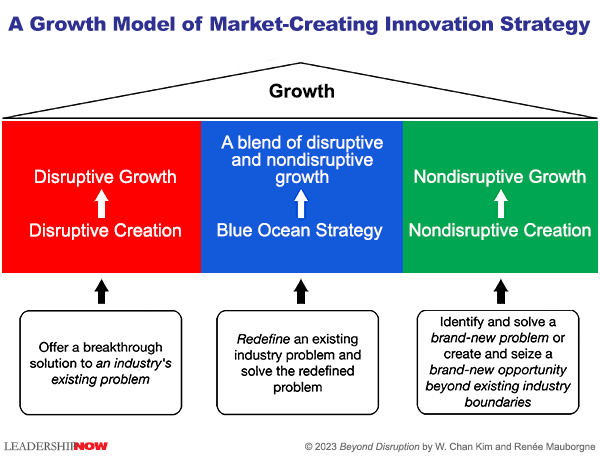
They have created a framework around three paths to market-creating innovation and growth. The type of path you end up on depends on the problem you are trying to solve or the opportunity you are trying to address—the question you are asking.

Market Creation

As seen in the chart above, offering a breakthrough solution to an industry’s existing problem sets you on the path to disruptive creation and disruptive growth. Identifying and solving a brand-new problem or seizing a brand-new opportunity outside existing industry boundaries sets you on the path to nondisruptive creation and nondisruptive growth. Between these two ends of the market-creating-innovation spectrum is redefining and existing industry problem and then solving the redefined problem. This is the essence of blue ocean strategy, which generates a more balanced blend of disruptive and nondisruptive growth.

Start With the Right Perspective

If you want to generate nondisruptive creation, you must start with the right perspective(s). There are three.

First, we tend to allow our thinking to be constrained by our environment rather than freed by our imagination. We are not bound by the world as it is. Look beyond the existing market and environment.

Second, nondisruptive creators don’t confuse the ends with the means. “They see technology as a great enabler but realize that value innovation—offering buyers a leap in value—is what ultimately creates a nondisruptive new market.” Instead of leading with technology innovation, lead with value innovation. “Successful nondisruptive creators think value innovation first, and then technology to achieve that end.” Stay focused on value innovation.

Third, nondisruptive creators look for creative ideas from anyone and everyone, not just from the “creative types.” “It takes a network of people with differing perspectives and skills to bring any nondisruptive creation into existence—to cultivate, refine, and collectively figure out what must be learned or unlearned and where the clues are as you draw from here and there and put it all together to realize your new offering.”

Once we have the right mindset, the task becomes making it happen. The second half of the book deals with how to identify, unlock, and realize the nondisruptive opportunity.

The challenge for governments and society will be to create new jobs that don’t displace others. That is as much an economic imperative as it is a moral one—which is another key reason why nondisruptive market creation is about to become even more important.

* * *
Follow us on Instagram and Twitter for additional leadership and personal development ideas.

* * *

 

Explore More

Tony Saldanha Innovation Mindset

from The Leading Blog: A Leadership Blog https://ift.tt/lpN8Dcr
via WordPress

Leading Thoughts for June 22 2023

Leading Thoughts

IDEAS shared have the power to expand perspectives, change thinking, and move lives. Here are two ideas for the curious mind to engage with:

I.

Scott Barry Kaufman and Carolyn Gregoire on mindful daydreaming:

“It may be wise to question whether we should always be living in the moment and whether this is the best way to foster creative thinking. Finding this ‘middle way’ between mindfulness and mind wandering can help us enjoy the optimal benefits of both ways of thinking. Mindfulness helps us truly see what’s around us—a skill of paramount importance in life and art—but it must be balanced with giving the mind space to dream, fantasize, and simply roam free.”

Source: Wired to Create: Unraveling the Mysteries of the Creative Mind

II.

Martyn Newman on how your self-confidence determines your success:

“If you grew up in an environment in which you were continually criticized, you probably learned to focus on your faults and inadequacies. You may do a number of things really well, but when you make a simple mistake, you enlarge it out of proportion. It’s like your attention is conditioned to ignore the things you have done well; instead, it is drawn like a magnet to focus on the negative parts of your performance. And there is a direct relationship between your performance in any area and your level of self-confidence.”

Source: Emotional Capitalists: The New Leaders

* * *

Look for these ideas every Thursday on the Leading Blog. Find more ideas on the LeadingThoughts index.

* * *
Like us on Instagram and Facebook for additional leadership and personal development ideas.


Explore More

Leading Thoughts Summer Reading 2023

from The Leading Blog: A Leadership Blog https://ift.tt/zDPJsmE
via WordPress

10 Things Humility Does That Pride Does Not

10 Things Humility Does

HUMILITY is the basis of servant leadership. Dale Burke explains what humility looks like and what it does in contrast to pride in How to Lead and Still Have a Life: The 8 Principles of Less is More Leadership.

1. Humility accepts responsibility. Pride blames others.

2. Humility promotes objectivity. Pride lives in denial and ignores the truth.

3. Humility increases teachability. Pride is close-minded and defensive.

4. Humility stimulates creativity. Pride lives inside our heads.

5. Humility expands flexibility. Pride is rigid and demands my way.

6. Humility boosts team morale. Pride inflates the self and deflates others.

7. Humility fosters loyalty. Pride looks out for the self and takes credit.

8. Humility pursues excellence. Pride sees itself as great but actually settles for mediocrity.

9. Humility brings balance. Pride demands control and has to do it all to keep control.

10. Humility promotes and maintains relevance. Pride lacks connection with others.

* * *
Follow us on Instagram and Twitter for additional leadership and personal development ideas.

* * *

 

Explore More

False Humility Humility Is New Smart

from The Leading Blog: A Leadership Blog https://ift.tt/ehWpdUR
via WordPress

10 Books You Should Read This Summer 2023

2023 Summer Reading

CARY GRANT enjoyed reading—often in the evenings with a scotch. He was inclined to read biographies, current affairs, and self-help books.

As a parent dedicated to learning, he especially loved reading to his daughter Jennifer. She remembers, “I can still feel the perfect ease of our Hampton summer days, swimming, boating, tennis, reading, and backgammon by the pool with burgers. Divine.” He told his daughter, “One must always be careful with books and treasure them.”

The summer is a perfect time to relax and read, taking time to reflect. Also, as Wally Bock suggests, take the time to pick up something you’ve always wanted to read, something fun to read, and perhaps re-read a book that will help you to reconnect. Here are ten suggestions for books to inspire you and help to grow your leadership.

summer reads   The Creative Act: A Way of Being by Rick Rubin – (January 2023)

summer reads   Finding the Way: The Entrepreneur’s Tale by Cap Treeger – (January 2023)

summer reads   Good Power: Leading Positive Change in Our Lives, Work, and World by Ginni Rometty – (March 2023)

summer reads   An Ordinary Man: The Surprising Life and Historic Presidency of Gerald R. Ford by Richard Norton Smith – (April 2023)

summer reads   The Wisdom of the Bullfrog: Leadership Made Simple (But Not Easy) by Admiral William H. McRaven – (April 2023)

summer reads   Generation Why: How Boomers Can Lead and Learn from Millennials and Gen Z by Karl Moore – (May 2023)

summer reads   Positive Chaos: Transform Crisis into Clarity and Advantage by Dan Thurmon – (June 2023)

summer reads   The Leap to Leader: How Ambitious Managers Make the Jump to Leadership by Adam Bryant – (July 2023)

summer reads   Power to the Middle: Why Managers Hold the Keys to the Future of Work by Bill Schaninger, Bryan Hancock and Emily Field – (July 2023)

summer reads   Master of Change: How to Excel When Everything Is Changing—Including You by Brad Stulberg – (July 2023)

* * *
Follow us on Instagram and Twitter for additional leadership and personal development ideas.


Explore More

Whats New in Leadership Books 4 podcasts

from The Leading Blog: A Leadership Blog https://ift.tt/wI1S9WG
via WordPress

Leading Thoughts for June 15 2023

Leading Thoughts

IDEAS shared have the power to expand perspectives, change thinking, and move lives. Here are two ideas for the curious mind to engage with:

I.

Boyd Clark and Ron Crossland on how leaders need to fill in the blanks:

“When leaders communicate facts alone, constituents fill in the emotional and symbolic blanks. The same is true for the other channels. We always fill in the blanks. Remember your brain works this way. When constituents fill in the blanks left by leaders, they construct a different message than the leader sent. Leaders, believing they have communicated completely, not fall into the fatal assumptions trap. What results is one of four things: a lack of understanding, a lack of agreement, a lack of caring, or a lack of appropriate action.”

Source: The Leader’s Voice: How Your Communication Can Inspire Action and Get Results!

II.

Scott Adams on knowing where to start:

“When you do something the wrong way, the people who know how to do things the right way will generally jump in to tell you what you are doing wrong. Take advantage of all that free advice.

“If you don’t know how to do something the right way, and Googling doesn’t help, the only alternative to doing things the wrong way is to do nothing at all. That’s loserthink. Waiting until you know how to do something exactly right is a poor strategy. You could be waiting forever. Better to jump in, make your mistakes, and see what kind of free assistance that attracts.”

Source: Loserthink: How Untrained Brains Are Ruining America

* * *

Look for these ideas every Thursday on the Leading Blog. Find more ideas on the LeadingThoughts index.

* * *
Like us on Instagram and Facebook for additional leadership and personal development ideas.


Explore More

Leading Thoughts Whats New in Leadership Books

from The Leading Blog: A Leadership Blog https://ift.tt/kMmsDZ8
via WordPress

Winning Teams Know to Trust Their Team Members

Demand Management

IN BUSINESS, as in sports, the aspect that distinguishes the best teams from the mediocre teams comes down to collaboration. Yet many times, companies struggle with sharing and aligning functional plans.

Too often, managers put their heads down and focus only on their own departments. But setting goals in functional silos and then hoping that everything works itself out across the organization is an unlikely path to success.

Instead, if they trust and coordinate with their cross-functional counterparts, they will be better able to synchronize plans. Doing so ensures that what they’re doing as an entire team will enable the achievement of the company’s overall business objectives — which often represents the difference between success and failure.

Let’s apply the team sport analogy further. In ice hockey, for example, players have a decision to make when the puck is passed to them. One choice is to take the puck down the ice on their own to attempt to score a goal. They may have significant incentive to do so — they may be close to breaking a personal record or they may believe that their chance to increase their scoring statistics will make them more marketable as a player. They also may not trust their teammates’ ability to score a goal.

An alternative choice is to pass the puck to another player who is in a better position and can make a coordinated play.

Faced with this decision over numerous games, team members detect the repercussions when individual members regularly attempt to go it alone. The loners come to be regarded dubiously by their teammates and lose a measure of respect. Consequently, others may not instinctively pass the puck to them. Such behaviors will have an impact on the team’s win-loss record — and not in the preferred category.

Consider this hockey analogy in a business context. Collaborating with other business functions is often an adjustment for sales and marketing leaders. Still, they can’t go it alone and expect to win the game. They often must consider broader implications when establishing commercial plans.

Once they focus on the betterment of the entire business, however, a shift in attitude occurs. Sales and marketing leaders become more mature in their thinking about the demand plan. They consider the demand plan a request for product that they’re accountable for selling.

The manufacturing organization is rarely an open bar, so to speak. Supply planners shouldn’t be forced to guess which of the demand mix, volume, or timing in the plan is going to come true, and which are hedges against possible poor performance from the manufacturing organization.

Similarly, with suitable coordination, the supply chain organization’s thinking shifts. They know the pitfalls of second-guessing the demand plan. The role of supply chain organization is to create a supply plan in response to the demand plan. This supply plan considers inventory, cost, and service level parameters that are deemed optimal.

Coordinating and synchronizing plans across functions enables coordinated responses to changes regarding both problems and opportunities. Doing so creates agility.

When upper management leaders play their positions and trust their teammates to do what they say they’re going to do in their plans, something else happens. Responding to change becomes much simpler and in some cases, effortless.

As in team sports, the regular synchronization of cross-functional demand plans in business is key to empowering teams to execute — and win.

* * *

Leading Forum

Greg Spira is an expert in Demand Management and Integrated Business Planning (IBP/S&OP) and works with companies to implement lasting change at all levels and across functions by building organizational capability and developing high-performing teams. He has written and co-authored many white papers on Demand Management and is an instructor of the Oliver Wight Demand Management course. His new book, Trust the Plan: Demand Management for Business Leaders (J. Ross Publishing, April 18, 2023), shares how to ensure cross-functional collaboration, alignment of plans, and teamwork in any Demand Plan process. Learn more at www.gregspira.ca.

* * *
Follow us on Instagram and Twitter for additional leadership and personal development ideas.

* * *


Explore More

11 Elements Needed to Achieve Collaboration Team Turnarounds

from The Leading Blog: A Leadership Blog https://ift.tt/cyB0xeq
via WordPress

Leading Thoughts for June 8, 2023

Leading Thoughts

IDEAS shared have the power to expand perspectives, change thinking, and move lives. Here are two ideas for the curious mind to engage with:

I.

John Daly on the importance of repetition:

“There is a wonderful story of a man who was so in love with a woman who lived far from him that every day, for 500 days, he mailed a love letter to her. On the 500th day, she married the postman. Exposure works. Up to a point, it can enhance decision-maker’s feelings toward an idea.”

Source: Advocacy: Championing Ideas and Influencing Others: Championing Ideas and Influencing Others (Blog Post) https://ift.tt/hSFQz01

II.

Neen James on deliberate attention:

“I think paying attention means listening with our eyes and our ears, thinking with our brains, understanding with our hearts, and giving with our souls. Deliberate attention means identifying the people, priorities, and passions that matter most in our lives and then purposefully and proactively focusing our conscious attention on them.

“Conscious attention is stopping what we are doing on the computer to give our full attention to a team member who comes into our office to talk.

“Deliberate attention is organizing your attention toward a particular purpose. It’s saying no to some things so you can say yes to the important things that deserve your time and focus.”

Source: Attention Pays: How to Drive Profitability, Productivity, and Accountability

* * *

Look for these ideas every Thursday on the Leading Blog. Find more ideas on the LeadingThoughts index.

* * *
Like us on Instagram and Facebook for additional leadership and personal development ideas.


Explore More

Leading Thoughts Whats New in Leadership Books

from The Leading Blog: A Leadership Blog https://ift.tt/nXHmIJQ
via WordPress

Good Team Leaders Checklist

Good Team Leaders Checklist

HIGH-PERFORMING teams have six characteristics: leadership, organization, communication, knowledge, experience, and discipline, says former Air Force F-115 pilot James Murphy. But among these, leadership comes first. Bad leadership will doom a team.

Leaders hold themselves accountable for the team’s performance. And great teams support each other.

In Courage to Execute he writes, “Leaders of high-performing teams encourage their people to ask these two questions: First, is there someone on my team that needs my help in achieving our objectives? Second, do I need help from someone on my team to achieve our objectives?

Murphy offers a Good Team Leaders Checklist to ensure you are creating a positive team environment on a daily basis:

○ Take responsibility: A team owns success; a leader owns failure.

○ Enforce accountability for themselves and their team members.

○ Model an Appropriate example.

○ Reinforce standards and processes.

○ Cultivate situational awareness.

○ Listen actively.

○ Facilitate collaboration.

○ Delegate, trust, and develop leadership in others.

○ Orchestrate mutual support.

○ Thank and reward team members.

* * *
Follow us on Instagram and Twitter for additional leadership and personal development ideas.

* * *


Explore More

Courage to Execute 4 Characteristics of Great Teams

from The Leading Blog: A Leadership Blog https://ift.tt/ja1b2tu
via WordPress

Generation Why: How Boomers Can Lead and Learn from Millennials and Gen Z

Generation Why

MUCH has been written about how the Millennial and Z generations are different, their likes and dislikes, and idiosyncrasies. In Generation Why: How Boomers Can Lead and Learn from Millennials and Gen Z, McGill University professor Karl Moore asks why. He goes behind the observable behaviors and looks at the events that shaped their worldview to better understand why they are the way they are.

Every generation has experienced pivotal events and cultural forces that have shaped their lives and how they react to life. Depression-era kids move differently in the world as they grow older than those that grew up in more prosperous times. Their worldviews are different, so they see the world through different values, expectations, and motivations. I am a Boomer, so my view regarding trust, authority, and truth, for example, is different than those generations that came after me.

The Millennial and Z generations have a Postmodern worldview states Moore. Our education has a huge impact on how we believe the world does and should work. Moore writes:

What university students are taught during pivotal years of their schooling very much influences their behaviour at work and their view of how they want to be led. Though, given their worldview, led may be too strong a word – even manage may be too strong. Perhaps it would be better to say, worked with.

To better understand the Millennial and Z generations, I believe it is helpful to look at their education and the underlying ideas that the education system taught them – that is, their Postmodern worldview. Rather than cover the whole of Postmodern thought, this book focuses on the aspects of their worldview that impact their perception of leadership and work.

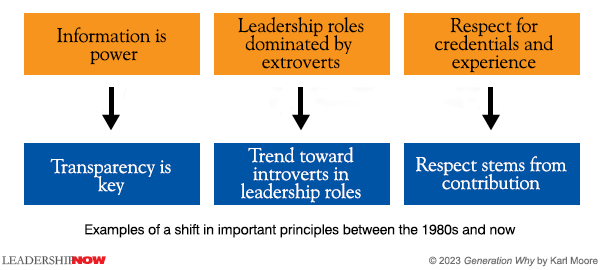
The world has changed, and what many of us have been taught is no longer relevant in today’s world. The chart below illustrates some of this change.

Generation Why

The Millennial and Z outlook involves contemporary perspectives on four important leadership issues, which Moore examines in this book:

  • knowledge and truth – who has them and who controls them
  • hierarchy and its considerable decline
  • the way people relate to one another
  • the role of emotions in the workplace

Moore interestingly observes, “The knowledge of younger generations, to them, feels (most often, rightfully) more relevant and valuable than the “dated” understanding of the older generation. To a considerable degree, we older people are just not as valuable as older people were thirty years ago when we were starting out.”

After a fascinating look at where these new generations’ worldviews came from, Moore then offers tips on how to work more effectively with Postmoderns, such as:

Privilege all voices. Slow down and listen. “Millennials/Zers firmly believe that their story, or their personal and subjective truth, is as good as anyone else’s, regardless of their shortcomings in experience, age, or educational achievement. However, I argue that, contrary to popular belief, Millennials are not acting entitled, they are simply misunderstood. This is part of a larger characteristic of the Millennial/Z generations, which can be described as the death of meta-narratives and the rise of micro-narratives.”

Be authentic. This is a complex area that Moore explains well, incorporating a look at both constructive authenticity and existential authenticity. “It appears that “being comfortable with oneself ” and “knowing who one is” are the most relevant attributes of Postmodern authenticity.”

In the age of social media, authenticity for Millennials/Zers is characterized by the consistency and continuity between their online personas and their lives. The more congruence there is between the two, the more authentic a person will appear to be to their peers.

Create purposeful organizations and align personal and professional purpose. Nearly everyone wants to find meaning in their work. What is unique to Millennials and Gen Zers is that they were “found to be seeking purpose and meaning at such an early stage in their careers.” Millennials and Gen Zers tend to be loyal to roles or identities rather than to specific companies or organizations and thus want to feel a sense of control over their careers.

Mentor (and reverse mentoring). Millennials and Zers often crave one-to-one relationships in the form of mentors. They are “hungry for great mentors who are willing to put in the time, accept multiple mentees, and be reverse mentored.” Because of the coaching and feedback received throughout their formative years, Millennials/Zers likely view their mentors as parental figures or teachers, rather than in the traditional role of employer or boss. Millennials/Zers surround themselves with a network of coaches; many Millennials/Zers have several advisors they turn to throughout their careers, for issues both major and minor.” Be open to reverse mentoring too. “Reverse mentoring, done well, can result in better-aligned strategies with a turbulent world and more implementable strategies for the whole organization.”

Give feedback. Millennials and Zers need feedback. They depend on it. Moore explains why. Managers can use the SKS framework both to provide effective feedback: What should I stop doing? What should I keep doing? What should I start doing?

Generation Why will help you to understand not only the Millennial and Z generations but also your own. These understandings will help any leader to form a basis for mutual respect and a productive and healthy work environment.

* * *
Follow us on Instagram and Twitter for additional leadership and personal development ideas.

* * *


Explore More

Tim Elmore Generation iY Generational Divide

from The Leading Blog: A Leadership Blog https://ift.tt/aIlQG4s
via WordPress