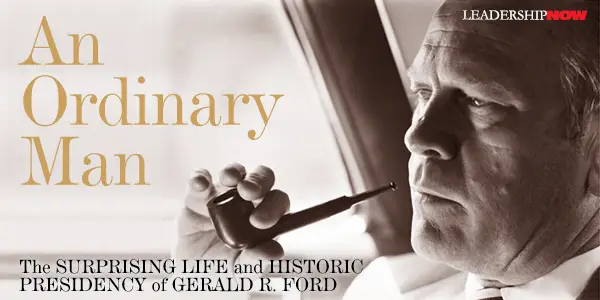
An Ordinary Man: Gerald R. Ford

Ordinary Man

GERALD FORD was an inner-directed leader that gave him quiet strength. He didn’t indulge his ego. A leader with the courage to do what needed to be done despite the consequences. Richard Norton Smith’s extraordinary biography of Gerald Ford, An Ordinary Man, pulls together multiple perspectives to give essential insights into Ford’s thinking and leadership.

Ford had moral authority because he lived his values. He believed that you could disagree without being disagreeable. Never taking himself too seriously and wanting to do what was best for the country, he recruited people who knew more than he did about the issues he faced.

Ford possessed what Pulitzer Prize-winning author John Hersey called a “stubborn calm at the center” and “a glacial caution.”

Curated below are some notes from An Ordinary Man:

☙ “The strongest weapon in a political campaign is the good credited you by word of mouth”—this Ford credo goes a long way toward explaining him and the congressional mindset he personifies. By stressing individual contacts over ideological mandates, Ford defines leadership in transactional terms, constituent service on a grand scale.

☙ When asked the secret of his political success, Ford reveals more than he perhaps intends by replying, “I made everyone else’s problems my problems.”

☙ “Ford never doubted the contribution of college sports to his character or career. Teamwork and grueling preparation were educational values in themselves. The discipline to absorb defeat without yielding to defeatism, to distinguish between constructive criticism and the shouted abuse of armchair quarterbacks—these and other lessons served Ford as guideposts in his political travels.”

☙ As a new congressman, “Ford could often be found at his desk on weekends as well. Frequently Betty joined him there, filing papers or just enjoying his company.”

☙ JFK beckoned to Gerald and Betty Ford to return to Washington on the presidential yacht Honey Fitz. That the Fords should find their names on the most exclusive guest list of the season was no accident. JFK had long since taken the measure of his onetime House colleague. He knew that Ford’s opinion carried weight among lawmakers of both parties, especially on issues of military spending and foreign aid.

☙ Representative Charles Goodall on Ford as Minority Leader: “Of course, he was a nice guy. Even his critics liked him … His secret was that he was almost totally non-vindictive, and he made the effort to make people feel that they were part of the leadership team.”

☙ With counselor Robert Hartmann, former Washington bureau chief for the Los Angeles Times, on the payroll, “Ford could indulge his habit of seeing the good in people, knowing he had another set of eyes to detect and defend against their less admirable qualities.”

☙ In pardoning Nixon, Ford said he had hoped “to change our national focus … to shift our attention from the pursuit of a fallen President to the pursuit of the urgent needs of a rising nation.”

☙ Ford said, “If there’s no place in politics for human compassion, there’s something wrong with politics.”

☙ In visiting Japan and South Korea, “He navigated minefields of controversy with a common touch and uncommon sensitivity to the feelings of his hosts.”

☙ He was “Paying for the mistakes of the last four decades, “Observed George Reedy, onetime White House press secretary to Lyndon Johnson. “He’s been run over by history.”

☙ “Presidents are judged in part by the company they keep, the talent they attract, and their ability to work with subordinates who may surpass them in IQ and charisma.

☙ Don Rumsfeld told Ford, “You know, as you look ahead, you have to have something that you are pushing for. Otherwise, you are not leading.”

☙ Approaching his first anniversary in the Oval Office, there was widespread agreement that the trappings of office had done nothing to inflate Ford’s ego.

☙ “Ford Is Mr. Right,” proclaimed Newsweek. “A kind of anti-hero whose homely virtues of thrift, honesty, hard work and modesty about the capacities of government exactly suit a diminished national mood.”

☙ “Ford wasn’t that type of man. He wasn’t someone who attempted to sell things by packaging them for the media.”

☙ Ford said at the 1975 Helsinki conference, “History will judge this conference not by what we say today, but by what we do tomorrow—not by the promises we make, but by the promises we keep.”

☙ Clarence Mitchell, chief Washington lobbyist and spokesman for the NAACP, said of Ford that despite their political differences, “nothing will ever change the fact that you entered the office at a time when the Nation was in great travail and you left it with the respect and, in many instances, the affection of your supporters and many of your opposition as well.”

☙ Harry McPherson, Lyndon Johnson’s White House counsel, wrote, Ultimately Ford had been a successful president not because he was clever, articulate, or a man of vision, “but because he was honest, straightforward, forgiving and possessed of sound judgment.”

☙ Acknowledging his contemporary opposition to the Nixon pardon, Ted Kennedy said, “Time has a way of clarifying past events, and now we can see that President Ford was right.”

President Ford

☙ “For a man said to lack guile, Ford had an unusual appreciation of the pipe as theater prop. ‘I learned that if you want a little time to think about something, you can go through the process of filling a pipe, lighting it, and it gives you … time to digest, to analyze, and make a decision.’”

* * *
Follow us on Instagram and Twitter for additional leadership and personal development ideas.

* * *


 

Explore More

Reactions to Gerald Fords Death Gerald R Ford Dies

from The Leading Blog: A Leadership Blog https://ift.tt/PMU85rc
via WordPress

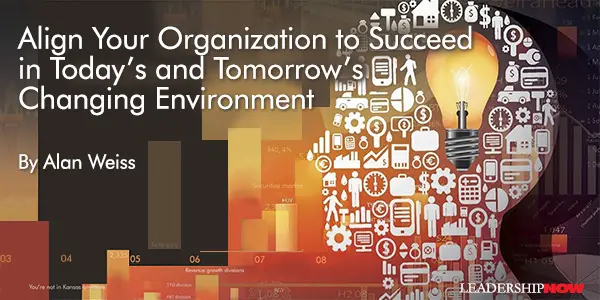
Align Your Organization to Succeed in Today’s and Tomorrow’s Changing Environment

Align Your Organization

THE PANDEMIC threw all strategies into the junkyard. We now have the opportunity to deal with new realities, but that calls for an entirely new approach to half-century-old strategic processes.

Conduct your “forensic implementation analysis” to examine these five dynamic forces:

1. Which Practices to Sustain

In this dynamic, you are doing things today that will also serve you well in the future in achieving your vision.

Ford’s F-150 pickup truck is the best-selling vehicle in the U.S. and has been for some time. It will probably maintain this status in the immediate future. Ford needs to sustain that type of vehicle and capabilities, whether powered by gas, batteries, hydrogen, or advertising heft.

My landscaper has been working with different crews for the 30 years I’ve known him. He consistently sustains a scientific method about grass height, shrub diseases, removal of pests, and so forth. His equipment has changed as his crews have, but not the criteria he uses to keep the property looking great.

2. Which Practices to Improve

You may currently be conducting business and engaging in actions that are working well now but won’t be for the future. You can build on their momentum by altering and changing them to maximize progress toward your vision.
Championship golf courses use an architecture and difficulty that challenge the best in the world. But as the best keep getting better (improved equipment, better conditioning and strength, smarter course management, better coaches and caddies), it’s vital to improve the courses to meet the new abilities. Second and third cuts of growth may be made longer, bunkers deeper, and hold lengths extended. And the Professional Golf Association (PGA) also makes new rules to adjust to advances, including how many clubs players may carry and what kinds, the construction of the ball, and so forth.
The improvements have to be consistent with an existing strength that required augmentation if it’s to remain effective in helping to drive the enterprise forward.

3. Which Practices to Jettison

The poorest-run organizations refuse to fire people. Sometimes the excuse is legal concerns, and sometimes it’s someone in human resources trying to prove the department is actually important. Yet terminating poor performers is a service to the performer as much as to the organization.

And too many organizations hold on to processes and procedures that not only will not help to reach the vision, but will usually impede progress.

4. Which New Practices to Retain

Some adjustments due to the pandemic led to a great many new and effective practices — such as take-out food from high-end restaurants, virtual meetings, and heightened streaming entertainment. What we improvised for the moment should be analyzed as potential longer-term factors for success.

You must identify those initiatives, innovations, and even behaviors that you may once have thought were temporary or ad hoc to deal with the pandemic but which are, in actuality, permanent advantages if you allow them to be.

5. Which Practices to Acquire

The greatest innovations have come in times of war, pestilence, natural disaster, and so forth. Aside from weaponry, warfare created huge advances in medicine, trauma treatment, and communications. Moreover, innovation needs to be rather immediate.

Strategically, you must look to acquisition in support for your strategic factors constantly, given changing times and priorities. You can’t look outside only when you’re failing inside!

The point of your new strategic alignment is to ensure that you sustain your strengths, improve what is good but needs to be better, retain what you’ve created, jettison what will no longer support the organization, and acquire what’s missing to lead you toward your vision.* * *

Leading Forum

Alan Weiss, Ph.D., is a consultant, speaker, and author. Through his consulting firm, Summit Consulting Group, Inc., he has worked with more than 500 leading organizations, including Merck, Hewlett-Packard, GE, Mercedes-Benz, The Federal Reserve, and the New York Times Corporation. He has published 60 books, many of which have been on the curricula at top business schools. His new book is Sentient Strategy: How to Create Market-Dominating Strategies in Turbulent Economies. Learn more at alanweiss.com.

* * *
Follow us on Instagram and Twitter for additional leadership and personal development ideas.

* * *
 

Explore More

Good Strategy Bad Strategy Strategy Book

from The Leading Blog: A Leadership Blog https://ift.tt/67oHPds
via WordPress

Leading Thoughts for May 4, 2023

Leading Thoughts

IDEAS shared have the power to expand perspectives, change thinking, and move lives. Here are two ideas for the curious mind to engage with:

I.

Susan Fowler on letting go of the notion that you can and should motivate people:

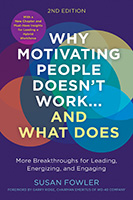
“Attempting to motivate people is a losing proposition, no matter your resources. Why? Because people are already motivated—but maybe not in the way you want. When you assume people aren’t motivated, you tend to fall back to strategies proven ineffective, wrongheaded, or even counter to what you intended. You incentivize, and when that doesn’t work, you add more carrots (rewards, incentives, bribes). When you run out of carrots, you may try wielding a thicker stick (threats, fearmongering, and punishment). At some point, you realize your attempts to motivate people are fruitless or, even worse, more harmful than beneficial.”

Source: Why Motivating People Doesn’t Work…and What Does, Second Edition: More Breakthroughs for Leading, Energizing, and Engaging

II.

Former NASA engineer-project manager and launch director at SpaceX John Muratore on the importance of purpose:

“Tom Holloway, a very famous Program Manager, and head of Flight Directors for a long time, told me something very interesting. He said, ‘People ask us what our greatest resource is, and we always say, ‘our people.’ We have some bright people, but the truth of the matter is we don’t have any better people than anybody else has. Our people aren’t our greatest resource. Our sense of mission is our greatest resource. When we lose our sense of mission, we are in the most jeopardy. When we have a high sense of mission, we can overcome any obstacle. Where we get in trouble is where we lose the sense of mission. We get wrapped up in politics, we get wrapped up in budget and schedule. We get wrapped up in personal issues. If we want the best for NASA, we’ve got to keep our mission, focus on what’s our mission.’ If our activity is not clearly, demonstrably, absolutely, most effectively supporting that mission, we’ve got to change what we’re doing. No matter how painful or how difficult. Because our people sense it, and then we no longer get the best out of them.

“Finding what the mission was and instilling that sense of mission in our people has always been the difficult challenge, and it’s probably the most difficult challenge today because I think people are confused beyond all shadow of a doubt right now about our mission. They don’t understand what the mission is, and that’s the biggest challenge. I think the cool thing about it is that’s something we can do something about it. It’s something totally within our control.

Source: NASA Johnson Space Center Oral History Project Interview, May 14, 2008

* * *

Look for these ideas every Thursday on the Leading Blog. Find more ideas on the LeadingThoughts index.

* * *
Like us on Instagram and Facebook for additional leadership and personal development ideas.


Explore More

Leading Thoughts Whats New in Leadership Books

from The Leading Blog: A Leadership Blog https://ift.tt/QeZy1CV
via WordPress

First Look: Leadership Books for May 2023

First Look Books

HERE’S A LOOK at some of the best leadership books to be released in May 2023 curated just for you. Be sure to check out the other great titles being offered this month.


9780228016878Generation Why: How Boomers Can Lead and Learn from Millennials and Gen Z by Karl Moore

Perhaps more than ever before, young people entering the workforce are searching for meaning and authenticity in their careers. This book helps managers understand the postmodern worldview held by generation Z and younger millennials, how it influences their behaviour at work, and how they want to be led in the workplace. Karl Moore takes a practical and down-to-earth approach to understanding what drives millennials and generation Z and how the education system they were brought up in has informed their worldview. Focusing on listening, purpose, reverse mentoring, feedback, and how people relate to each other in the workplace, Generation Why provides the essential tools for effectively working with millennials and generation Z and unlocking their full professional potential.

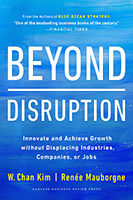
9781647821326Beyond Disruption: Innovate and Achieve Growth without Displacing Industries, Companies, or Jobs by W. Chan Kim and Renée A. Mauborgne

Blue Ocean Strategy forever changed how the world thinks about strategy. Now W. Chan Kim and Renée Mauborgne offer up a bold, new idea that will transform how we all think about innovation and growth. Disruption dominates innovation theory and practice. But disruption, for all its power, is destructive—displacing jobs, companies, and even entire industries. Are we missing an alternative approach to innovation and growth? In Blue Ocean Strategy, the authors, reveal another way to innovate and grow. Beyond Disruption redefines and expands the existing view of innovation by introducing a new approach, nondisruptive creation, that is free from the destructive displacement that happens when innovators set out to disrupt.

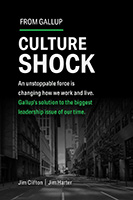
9781595622471Culture Shock: An unstoppable force has changed how we work and live. Gallup’s solution to the biggest leadership issue of our time. by Jim Clifton and Jim Harter

The COVID-19 pandemic caused an awakening that shocked the world — a structural change in how and where people work and live. One thing we now know for certain: Nothing is going back to normal. How organizations adapt to this culture shock will determine whether they thrive or even survive and whether U.S. and global productivity will go up or down. The immediate danger is that most employees will now operate more like independent contractors or gig workers than employees who are loyal and committed to your organization. The risk grows as your workforce’s mentality continues to shift from my life at work to my life at home. It may become nearly impossible to create a culture of committed team members and powerful relationships at work. How will you maintain your customers’ commitment when you’re struggling to create a culture of dedicated employees who build and strengthen relationships with those customers?

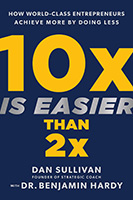
978140196995010x Is Easier Than 2x: How World-Class Entrepreneurs Achieve More by Doing Less by Dan Sullivan with Dr. Benjamin Hardy

Dan Sullivan, the world’s leading coach for highly successful entrepreneurs, wants you to know that achieving 10X growth is exponentially easier than striving for 2X growth. Most find this idea confusing at first because simply imagining 10X growth causes them to think they need to do 10X more work to achieve it. However, being a 10X entrepreneur is nothing like what most people think. 10X is not the outcome; it’s a counterintuitive process you can apply every time you want exponential growth in your life and business. To make 10X possible, you must focus on expanding what Dan defines as your four most important freedoms—time, money, relationship, and purpose.

9780593715543The Song of Significance: A New Manifesto for Teams by Seth Godin

What if we could create the best job someone ever had? What if we had that job? The workplace has undergone a massive shift. Remote work and economic instability have depressed innovation and left us disconnected and disengaged. Paychecks no longer buy loyalty, happiness, and effort. Alarmed managers are responding with harsh top-down edicts, layoffs, surveillance and mandatory meetings. Workers are responding by quiet quitting and working their wage. There is a better answer, a human answer, and it is within everyone’s reach. Godin brings us a powerful vision of how we can change the course. The choice is simple: either we keep treating people as disposable, and join in the AI-fueled race to the bottom—or we come together to build a significant organization that enrolls, empowers, and trusts everyone to deliver their best work, no matter where they are.

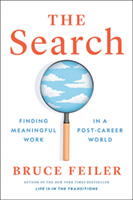
9780593298916The Search: Finding Meaningful Work in a Post-Career World by Bruce Feiler

Unprecedented numbers of Americans are quitting their jobs, rethinking their routines, breaking away from stifling expectations. We’re still living through the Great Resignation and quiet quitting. The most suffocating iron cage of all is the premise that each of us must have a career. We must follow a linear path of success, locking into a dream early, always climbing higher, never stopping until we reach the top. Few ideas have created more misery, squandered more human potential, or ruined more relationships. Feiler resolved to help us all imagine better. After dismantling the three lies about work, Feiler lays out the one truth: that each of us must write our own story. Showing that the people who are happiest at work don’t climb, but dig, Feiler introduces the six questions to ask in a workquake that allow us to perform a meaning audit, tapping into our truest selves and our deepest hopes to create the meaning we crave and the success we deserve.

More Titles

9781523004126 9780063284289 9780374279295 9781250281449

9781647825119 9780593491393 9780593654521 9780063210097

For bulk orders call 1-626-441-2024

* * *
“… a mind needs books as a sword needs a whetstone, if it is to keep its edge.”

— George R.R. Martin, A Game of Thrones

* * *
Follow us on Instagram and Twitter for additional leadership and personal development ideas.


Explore More

Whats New in Leadership Books Best Books of 2022

from The Leading Blog: A Leadership Blog https://ift.tt/p9dEhXw
via WordPress

LeadershipNow 140: April 2023 Compilation

LeadershipNow Twitter

twitter Here are a selection of tweets from April 2023 that you will want to check out:

See more on twitter Twitter.

* * *
Follow us on Instagram and Twitter for additional leadership and personal development ideas.


Explore More

Wonderhell Grace Under Pressure

from The Leading Blog: A Leadership Blog https://ift.tt/uIiEfAa
via WordPress

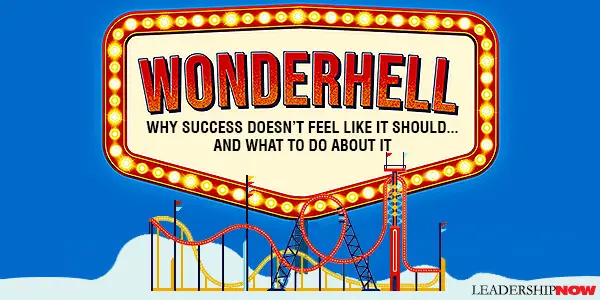
Wonderhell: Why Success Doesn’t Feel Like It Should

Wonderhell

SUCCESS is not a destination but a journey. And each achievement opens yet another door to our potential. The achievement feels wonderful, but just when we thought we reached to top, we feel the burden of the invitation to take another step into our newfound potential. We’re in what Laura Gassner Otting identifies as Wonderhell.

Wonderhell is that place between who you are and who you are becoming. The wonderful excitement of who you are and the burden (hell) of the realization of who you can become.

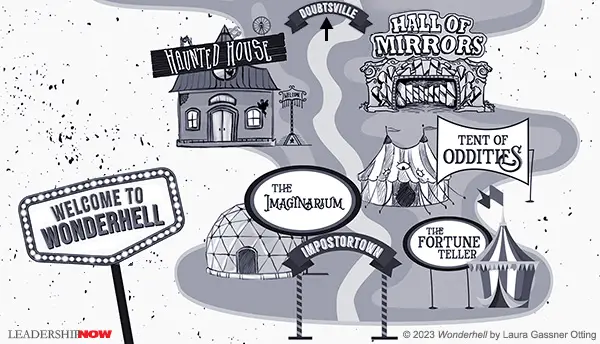
In Wonderhell: Why Success Doesn’t Feel Like It Should . . . and What to Do About It, Otting presents the ride of your life like entering an amusement park—Wonderhell. And every success invites us back to the entrance to take the ride again.

Just when we thought we could rest on our past, we are invited into a future of new opportunities. We step into the Imaginarium, and we can see the new life we want to have. It’s bigger and bolder, and we enter Impostertown. Who am I to take this next step? Who do I think I am? Otting wisely points out that we are not who we think we are. We are not what others think we are. We are who we think others think we are.

It’s time to deal with our inner voice. “Standing on the edge of our incompetence” makes us fearful and feel like an imposter. “You could run from this fear. You could hide from this future. You could lie to yourself about what you want. Many people do, swallowing that dream down into their belly, where it becomes a cancerous lament, festering away disguised as malaise, dissatisfaction, or worse, prudence.”

In Impostertown we see the fortune teller and enter the Hall of Mirrors, the Tent of Oddities, and the Haunted House. We learn to make our own luck, let go of the things that hold us back, and turn our limitations into invitations. Stick to the facts. They are greater than our emotions. “The more we observe and absorb information about a potential change, the more we begin to understand how to make that change happen,” and make our own luck.

Wonderhell Amusement Park

Once we’ve gotten rid of that internal voice in our head that limits us, we now enter Doubtsville. We face the uncertainty, the discomfort, and doubt about our new potential. It’s a rollercoaster of emotions. You will never be ready. Control what you can control and take the first step. Accountability motivates.

Much of the fear and anxiety that comes from all of the external voices. In Doubstville, we learn to create boundaries over who we listen to. We turn up the volume on those who believe in us and turn down the volume on those who only see our faults and obstacles. “Got a family member who always worries you’re taking too big a risk? Share some details of your plan when you’ve already got it in place. Bear in mind: most of the people who are busy sharing opinions wouldn’t have the time to do so if they were just as busy as you, bringing their own goals to fruition.” Who do you need to have on your team?

You’re on your way, but there’s one more dimension to the amusement park: Burnout City. “Wonderhell isn’t just a place you visit once. If you have a vision (and the stomach for going after it), you get to come back over and over again. Anticipate this repeat voyage—and even welcome it!—and you’ll live to tell the tale. But he key isn’t just to survive Wonderhell. Your goal is to thrive in it.”

You might be tempted to hold on to where you’ve already been, but that will slowly steal your wonder and leave you with nothing but the hell.

Performing the same roles and responsibilities over and over—even as this brings you greater and greater success—leaves you with nothing but emptiness and tedium.

If this sounds familiar, it’s time to break the monotony and step into the unknown. Say goodbye to your past success, and prepare to jump out of that perfectly-functional-but-entirely-automated airplane. Increase the challenge. Build a new offering. Or pack your parachute and move on.

Understanding how the rides work reduces our stress and helps us to enjoy the ride. If we are in Wonderhell, we’re on the right track to live out our potential.

* * *
If you have a dream, a plan, a demon, a potential, or an unshakable goal that excites you and scares you at the same time, Otting offers the Wonderhell Quiz to find a way through it.

* * *
Follow us on Instagram and Twitter for additional leadership and personal development ideas.

* * *
 

Explore More

Cognitive Reappraisal Success Equation

from The Leading Blog: A Leadership Blog https://ift.tt/M2C8x41
via WordPress

Leading Thoughts for April 27, 2023

Leading Thoughts

IDEAS shared have the power to expand perspectives, change thinking, and move lives. Here are two ideas for the curious mind to engage with:

I.

INSEAD professor Manfred F. R. Kets de Vries on wisdom:

“Wise people recognize that life moves with an ebb and a flow. There will be highs and lows and there will be peaks and valleys. Life is never going to be an easy ride, but during this journey that is your life there can be discovery, change and growth if that is what you seek. During this journey, you can have a choice: you can acquire wisdom or you can remain blinded. What you decide to do is all up to you.
This journey towards wisdom very much implies living in the present, planning for the future, and profiting from the past.”

Source: Leading Wisely: Becoming a Reflective Leader in Turbulent Times

II.

Adam Markel on what’s worth fighting for:

“Part of keeping calm is just doing the thing that’s I front of you and not getting your emotions lost in fighting battles about what is fair or unfair. That’s a losing proposition. Even when we’re correct and we’re fighting over what is fair or unfair, we’re losing. There’s right and there’s wrong. That’s different. That’s worth fighting for.”

Source: Change Proof: Leveraging the Power of Uncertainty to Build Long-term Resilience

* * *

Look for these ideas every Thursday on the Leading Blog. Find more ideas on the LeadingThoughts index.

* * *
Like us on Instagram and Facebook for additional leadership and personal development ideas.


Explore More

Leading Thoughts Whats New in Leadership Books

from The Leading Blog: A Leadership Blog https://ift.tt/Zh06r8z
via WordPress

The Four Workarounds

The Four Workarounds

WORKAROUNDS are a deviation from the norm. They are nonconformity. Conformity isn’t all bad; we often do it without much thought. But there are times when we are better served when we ask why and perhaps deviate from the expected.

Oxford University professor Paulo Savaget makes a distinction between disobedience and deviance in The Four Workarounds: Strategies from the World’s Scrappiest Organizations for Tackling Complex Problems. He says that disobedience isn’t the opposite of conformity. “Disobedience blatantly antagonizes the establishment, and the establishment almost always retaliates in kind. Deviance, on the other hand, is trickier. Deviance entails unconventional approaches that use parts of the status quo that work (as intended or not) in order to change the parts that don’t.” Deviance is the opposite of conformity.

Savaget identifies three approaches to deviance or standing out from the crowd. First, there’s confrontation which “always means clashes against dominant power structures.” Second, there’s negotiation to put pressure “on authority figures to legitimize changes in the system of rules.” And finally, there’s the workaround. “Through workarounds, we can promptly get things done and defy the status quo without directly antagonizing rule enforcers.” Workarounds are the lower-risk option for moving something along.

There are four workarounds each using a different attribute. Knowing each approach can help you determine the best response to getting things done.

The Piggyback

“The piggyback workaround enables us to circumvent all sorts of obstacles and address our problems by using seemingly unrelated relationships.” The piggyback often creates relationships between unconventional partners. Piggybacks occur “between silos rather than in them.”

A couple solved a problem of distributing life-saving medicines in Sub-Saharan Africa by piggybacking on the distribution of Coca-Cola that was readily available in the region. Oreo piggybacked clever Twitter advertising on the 2013 Super Bowl power outage.

The Loophole

“The loophole either capitalizes on an ambiguity or uses an unconventional set of rules when they aren’t the most obviously applicable.” In looking for loopholes, remember that “there’s often more than one way to be right, and simply following or breaking rules isn’t always the best way to get something done. Often there is an option that lies in between.”

The Roundabout

A roundabout may not solve the problem, but it can buy us time until we can find a permanent solution. It can be useful if you use that time wisely. “Roundabouts don’t so much tackle systemic challenges as interrupt self-reinforcing behaviors and but time to mobilize, negotiate, and develop alternatives, alleviating an urgent problem while building momentum to pivot in a different direction.”

The Next Best

Next-best workarounds use what is available to solve an immediate goal. “Using limited resources, scrappy organizations and mavericks teach us that often the best step forward is not focusing on what the ideal ought to be, but instead drawing attention to available opportunities that tend to be ignored.”

A great example of a next-best workaround is the non-profit Rainforest Connection to thwart illegal logging. By repurposing old cell phones strategically placed in the rainforest to listen for the sound of chainsaws, they are able to send real-time alerts to rangers and community patrols with the location of the logging to catch loggers in the act.

Each of the workarounds has a primary element at play. When you think about piggybacks, consider the existing relationships in your situation. Loopholes require paying close attention to different sets of rules. Roundabouts involve examining behaviors that lead to inertia. And if you’re searching for next-best approaches, fiddle with the resources you have on hand. Not every situation is going to necessitate using each of these four workarounds, and that’s okay. In the end, you really only need one workaround for most challenges.

* * *
Follow us on Instagram and Twitter for additional leadership and personal development ideas.

* * *


Explore More

The Hidden Habits of Genius Downstream World

from The Leading Blog: A Leadership Blog https://ift.tt/30DFpVU
via WordPress

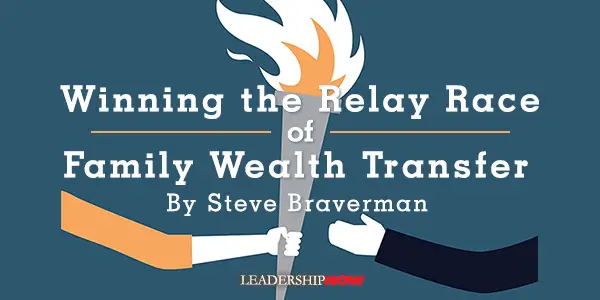
Winning the Relay Race of Family Wealth Transfer

Family Wealth Transfer

TOO MANY grantors feel that just preparing the documents for the
passing on of the wealth — such as setting up a trust — is the end of the process. But it’s really just the beginning because their inheritors need to be prepared to deal with the wealth.

Grantors need to share what they’ve learned about managing wealth. If they don’t, it’s like putting someone into a relay race with no coaching or training. They’ll be paralyzed, or they’ll stumble and fall, or they’ll be pushed off the track.

The way I like to describe wealth management and transfer is that it’s like running a relay race. This metaphor captures the process and the spirit in which we need to take on that process.

Looking at the relay race historically, the first runner is the one who initially created the family wealth. That may have happened some time ago in your family, or you may be that first runner. The baton represents the wealth itself. The other runners are the generations to whom that wealth will be passed.

If you’ve ever watched relay races, you know that passing the baton is often the trickiest part. Many of them get dropped, making it impossible for the team to win the race. But even if the passing of the baton is smooth, each runner must know how to make the most of their strengths and be passionate about how to run the race in order to advance the baton as successfully as possible. When you or anyone else in your family is running their leg of the wealth race — working with the wealth they’ve inherited — they need to know their strengths and be passionate about how they’re using the opportunity that this wealth provides.

In order to run a successful race, the teammates must help and support one another. The veteran runners must share their knowledge and provide support for the rookies. The rookies must be allowed to figure out what kind of approach to running their leg of the race will motivate and excite them and will keep them going when the running gets difficult.

Usually, teams need a coach to help them make the most of their potential. It’s the same way with managing and passing on wealth — the experienced wealth managers in the family, and the coach, must educate the inexperienced members of the family. And they must allow those rookies to figure out how they can best employ the wealth being passed on to them, not dictate to them how to do that.

So, that’s the overall metaphor for wealth management and transfer that I use, and now we’ll look at each aspect of the race more closely.

When you’re handed the baton to run your leg, you are a steward of your family’s wealth management. You have the opportunity to use, develop, and hopefully increase that wealth. Just like a runner needs coaching and training to deal with the challenges that come up during a relay race — weather conditions, the state of the track, the behavior of opponents — you will require support and guidance to succeed at handling your inherited wealth, either from experienced people from within your family or from professional family advisor outside of it, or both.

But, at the end of the day, it’s your responsibility — and your opportunity — to run that leg of the race in a way that’s personally fulfilling for you. At the same time, you should always keep in mind that the baton, your wealth, isn’t just yours; you’re part of a team — your family — and the baton will be passed on to others. So make the most of your time with that baton!

By inheriting wealth, you’re given a lead in life, and you’re also given the opportunity to extend that lead for the next generation. How do you measure that lead? Dollars and cents? Impact on society? Successful perpetuation of the family legacy? It’s usually some of all of these things, but when you get to the end of running your leg of the race, you’re meant to transition to helping those who come after you to run the next leg successfully, to optimize their performance, to help them think through and adjust to any adverse conditions they might encounter.

In the wealth management and transfer process, if someone drops the baton, gets nudged off the track, or gets tripped up, you can be there to support them — the way a veteran athlete helps a rookie — by saying things such as, “Look, you’re not using the best technique” or “Hey, I can show you how you lost your lead there” or “There are ways to ensure you don’t get nudged off track.” You can talk to them and help them along. (This is something the wealth management “coach” can do, too.)

Veterans of dealing with wealth can share what they’ve experienced with the next generation, provide perspective, help them develop their own plan, and monitor their progress. You can share both the responsibility and the success. Because, in the end, what you’re all aiming for is to get the whole family to the top of the podium, shaking hands and celebrating their victory.

* * *

Leading Forum

Steve Braverman is a co-founder, former co-CEO, and now co-Chairman of Pathstone, an advisory firm to help clients create, manage, and preserve wealth across generations. His book, Your Time with the Baton – Winning the Relay Race of Family Wealth Stewardship (Advantage, March 7, 2023), shares how to embrace the opportunity of wealth management and transfer. Learn more at yourbatontime.com.

* * *
Follow us on Instagram and Twitter for additional leadership and personal development ideas.

* * *


Explore More

101 Things I Learned Is Business Just About Making Money

from The Leading Blog: A Leadership Blog https://ift.tt/x3Qduqz
via WordPress

Leading Thoughts for April 20, 2023

Leading Thoughts

IDEAS shared have the power to expand perspectives, change thinking, and move lives. Here are two ideas for the curious mind to engage with:

I.

As the new CEO of United Airlines, Oscar Munoz on listening:

“Perhaps it wasn’t as important that I proved to employees that I had all the answers to every problem. If I simply demonstrated that, before I intended to lead, I wanted to listen and learn from them, perhaps that would be enough to generate goodwill.

If I could just break down this wall of distrust, it would be more important than getting every decision right. The only way to do that was to speak honestly about where I came from, how I was raised, and the values my experiences in life had instilled in me.”

Source: Turnaround Time: Uniting an Airline and Its Employees in the Friendly Skies

II.

Bertrand Russell on how to grow old:

“Psychologically there are two dangers to be guarded against in old age. One of these is undue absorption in the past. It does not do to live in memories, in regrets for the good old days, or in sadness about friends who are dead. One’s thoughts must be directed to the future, and to things about which there is something to be done. This is not always easy; one’s own past is a gradually increasing weight. It is easy to think to oneself that one’s emotions used to be more vivid than they are, and one’s mind more keen. If this is true, it should be forgotten, and if it is forgotten it will probably not be true.

The other thing to be avoided is clinging to youth in the hope of sucking vigor from its vitality. When your children are grown up they want to live their own lives, and if you continue to be as interested in them as you were when they were young, you are likely to become a burden to them, unless they are unusually callous. I do not mean that one should be without interest in them, but one’s interest should be contemplative and, if possible, philanthropic, but not unduly emotional. Animals become indifferent to their young as soon as their young can look after themselves, but human beings, owing to the length of infancy, find this difficult.

Source: Portraits from Memory and Other Essays

* * *

Look for these ideas every Thursday on the Leading Blog. Find more ideas on the LeadingThoughts index.

* * *
Like us on Instagram and Facebook for additional leadership and personal development ideas.


Explore More

Leading Thoughts Whats New in Leadership Books

from The Leading Blog: A Leadership Blog https://ift.tt/gVKLc7D
via WordPress